
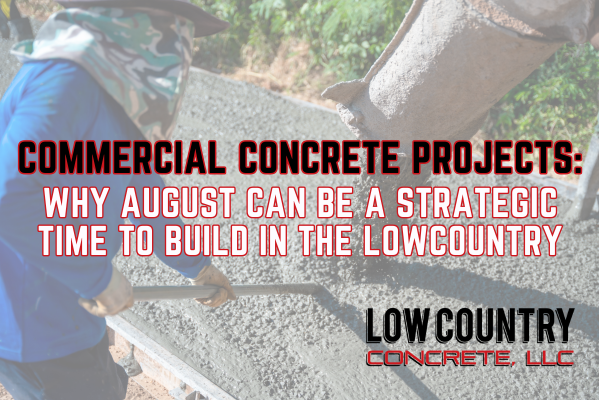
In the Lowcountry, where construction timelines are constantly at the mercy of heat, humidity, and tropical weather, choosing the right time to pour commercial concrete isn’t just a preference — it’s a strategy. And while August might sound like the worst time to schedule a slab or foundation due to the heat, it can actually be one of the most effective months for concrete work, if approached with proper planning.
For developers, general contractors, and facility managers in coastal South Carolina and Georgia — including Savannah, Bluffton, Beaufort, and Hilton Head — August brings a unique mix of advantages and watch-outs that can help keep your project moving on time and on budget.
What Makes August a Strategic Month
(Somewhat) Stable Ground Conditions
By late summer, the soil is more stable in sandy or loamy areas in the Lowcountry. That’s a major plus for site prep:
- You’re less likely to deal with waterlogged work areas.
- Equipment access improves without risking rutting or soft spots.
- Excavation and grading go faster, with better compaction results.
This is particularly important for slab-on-grade construction, parking lot flatwork, footings, or tilt-up panels — all of which rely heavily on a solid, level base.
Predictable Scheduling (in the Mornings)
Afternoon thunderstorms are common in the Lowcountry in August — no doubt. But Low Country Concrete contractors know how to work around it:
- Early morning pours are standard to avoid heat and storms.
- Shorter working windows are offset by better ground conditions and faster curing.
While it’s not a time for all-day pours, predictability is often better than in spring or fall, when rain can last all day or storms are larger and more disruptive.
Warm Weather Aids Curing (With Management)
Concrete cures faster in heat — and in August, that can be an advantage, if managed correctly. With temperatures in the upper 80s to mid-90s, crews must be prepared:
- Use hydration techniques like fog misting or curing compounds.
- Avoid hot afternoon pours to prevent surface cracking.
- Monitor wind and humidity for evaporation risks.
When done right, August pours can cure faster and stronger, allowing contractors to move forward with framing or vertical construction sooner than they could in cooler months.
Get Ahead of Hurricane Season and Fall Delays
August sits in a critical window: after the spring rains but before the peak of hurricane season in September. Pouring in August gives you:
- A head start on weather disruptions that typically begin mid-September.
- Flexibility to absorb minor delays before major storm systems potentially hit.
- Time to complete framing and enclosure before cold fronts and wet winter weather complicate things.
If your goal is opening in early 2026, laying concrete now gives you breathing room for everything that follows — from inspections to interior buildouts.
Strong Availability Before the Fall Rush
Once September hits, schedules tighten, especially as weather-related delays start causing project pileups.
Is August Right for Your Project?
In many cases, yes. If you’re pouring:
- A warehouse foundation
- Commercial flatwork or drive lanes
- Retail pad sites
- Parking lots
- Slabs for multifamily units
August is often one of the most productive times of the year in the Lowcountry, provided you work smart and plan ahead.
Low Country Concrete: Helping You Build Smart Before the Storms Hit
August isn’t a perfect month — but in the Lowcountry, there’s rarely such a thing as perfect. What it offers is a valuable combination of dry ground, fast cure times, and predictable scheduling (as long as you stay ahead of the afternoon storms). It’s also your last real opportunity to stay ahead of fall weather risks, subcontractor bottlenecks, and year-end construction slowdowns.
If you’re planning a commercial concrete project in the next 3 to 6 months, now is the time to act.
Need help planning the pour, assessing soil conditions, or scheduling in Savannah, Bluffton, or Hilton Head? Our team knows how to navigate the Lowcountry climate—and we’re ready to help you build it right the first time.
Recent Comments