
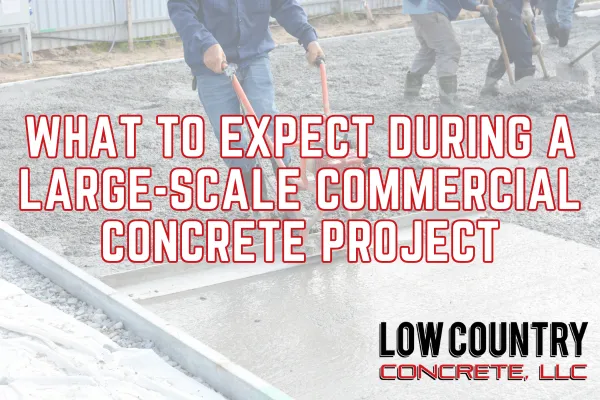
A large commercial concrete project involves much more than scheduling a concrete truck and pouring a slab. From site preparation and reinforcement to placement, curing, and final inspections, every stage needs to be coordinated carefully to keep the project moving safely and efficiently.
Understanding the commercial concrete process can help property owners, developers, and general contractors plan around site access, weather conditions, other trades, and project deadlines. Here is what to expect when working with Low Country Concrete on a larger commercial project in Savannah and the surrounding Lowcountry.
Site Evaluation and Project Planning
Before concrete work begins, the contractor needs a clear understanding of the site and project requirements. This may include reviewing plans, evaluating access for equipment and concrete trucks, confirming elevations, and determining how the work will be divided into manageable pours.
For commercial projects, coordination is especially important. Parking lots, retail pads, large slabs, and other concrete surfaces may need to accommodate heavier loads and more frequent traffic than residential concrete.
Preparing the Site
Proper site preparation creates the foundation for the concrete itself. Depending on the project, crews may need to remove existing material, excavate the site, establish grades, compact the subgrade, and install a suitable base.
Drainage is another important consideration in the Lowcountry. Heavy rainfall can quickly expose grading or drainage problems, so water movement should be considered before the concrete is placed.
Forms are then installed to establish the dimensions and elevations of the new concrete.
Reinforcement and Pre-Pour Preparation
Commercial concrete often requires reinforcement based on the project’s engineering and expected loads. Reinforcing steel, welded wire reinforcement, or other specified materials may be installed before the pour.
Crews also verify forms, elevations, access points, embedded items, and other project details. Catching an issue at this stage is much easier than trying to correct it once concrete placement has begun.
Concrete Placement and Finishing
Placement is one of the most visible stages of the commercial concrete process, but it requires considerable coordination behind the scenes.
Concrete trucks must arrive in an organized sequence, crews need adequate access, and the concrete must be placed and finished within appropriate working times. Large projects may be divided into multiple placements rather than completed in one continuous pour.
Finishing methods depend on how the surface will be used. A retail slab, parking area, sidewalk, or other commercial surface can have different requirements for texture, drainage, joints, and overall finish.
For an example of how these needs apply to commercial properties, see our concrete for retail projects article.
Curing and Protecting the Concrete
Placement does not mean the project is finished. Concrete needs time and appropriate conditions to develop strength.
Hot temperatures, humidity, direct sunlight, wind, and sudden rain can all affect how crews manage fresh concrete in coastal Georgia and South Carolina. Contractors may adjust scheduling or curing procedures based on conditions at the jobsite.
The concrete project timeline should therefore include curing and protection—not simply the day the concrete is poured.
Joints, Inspections, and Final Details
Depending on the project, control joints may be installed or cut to help manage normal shrinkage cracking. The work may also require inspections or other project-specific checks before areas are opened for use.
Crews can then complete final cleanup and coordinate when vehicles, equipment, tenants, or other trades can safely access the finished area.
How Long Does a Commercial Concrete Project Take?
There is no single concrete project timeline that applies to every commercial job. Project size, site conditions, engineering requirements, weather, inspection schedules, access, and the number of separate pours can all affect the schedule.
A straightforward section of commercial flatwork may progress relatively quickly, while a large parking lot or multi-phase development requires substantially more coordination.
Discussing these factors before work begins gives owners and contractors a more realistic schedule and helps reduce disruptions once construction is underway.
Plan Your Commercial Concrete Project With Low Country Concrete
A successful commercial project starts well before the first truck arrives. Careful preparation, organized placement, proper curing, and communication between everyone involved can make a major difference in both the schedule and the finished concrete.
Low Country Concrete provides commercial concrete services for projects throughout Savannah and the surrounding Lowcountry. Contact Low Country Concrete to discuss your upcoming commercial project and request a quote.
Recent Comments